• Concerts
  • Music
  • Mission
  • Blog
  • Contact
  • Hungarian

szekely-fono

Mozart and time management

2023.08.01.
conductor, Mozart, time management

As if there is no tomorrow / as if there is always a tomorrow. Which one is how you live? The thinking of our ancestors was obviously determined by the practically constant compulsion to make the above paradigm choice, and this is the basis of the dynamic tension of mundane / otherworldly life, which is the main foundation of Christian culture. If you live like that today, there will be an eternal tomorrow, but if you live like that, don’t even consider buying preserved milk, , you won’t survive to consume it.

Christianity by the left (or rather by the right), so we are left with paradigm number two. We are comfortably surviving the day, waiting for something to happen, everything is pleasant, our only fear is that the comfort of our survival mode may be even slightly ruined by some unexpected unpleasant event (illness, war, the neighbor drilling the wall on the weekend).

We work (?) a lot (?), but we also live well (?), we don’t need anything else, though more money would be nice. And that’s it. The old-fashioned question of what the hell it’s all for is only asked by adolescents or frivolous, naive dreamers, but it is not at all the subject of so-called social debate or common thinking (because what is the subject?, let’s interpose that at once). I don’t think that in earlier, more beautiful times peasants were leaning on their hoes, stopping every now and then in small groups, scratching their heads over the possible meaning of life, but the fact is that the vast majority of resources invested in common (material) efforts – in church, art, even political thought and action (war) – were somehow related to the above question, unlike in our own bright age, when even the semblance of such a connection shall be avoided. In Michelangelo’s time, the oligarchs were no meeker, nor the money-changers any more groovy, but the common manifestations of society – and here I include Michelangelo, who was obviously not a personal product of Julius II, but a product of the social expectations of his time – did produce Sistine Chapels, Mona Lisas and Gesualdo motets, moreover, in large numbers. The hundred years starting from the end of the 18th century, the century of Mozart, Goethe, Petőfi and Turner, could have been such an era. I read Mozart’s letters from his last months, and I am gripped by a terrible, overwhelming shame, and I am reminded of another of my shameful relatives: “what were you seeking on this earth…” (Kosztolányi)

We cannot imagine, comprehend, understand the frequency with which a Mozart (or a Liszt, or a Petőfi, or even a Salieri) lived in that age of perpetual death (only two of Mozart’s six children reached adulthood), nor do we mean by the word “live” what they might have meant. The hero of our title woke up at 5am at the latest, visited his friends by turns, wrote the first letters of the day (followed perhaps by more in the afternoon), listened to freemasonic lectures and attended meetings, arranged a school for his son, went to the opera every night, drafting applications for a job, copying speeches, having coffee with Schikaneder, while playing billiards, dealing with financial affairs, surviving constant illness and physical sickness, inadequate heating, poor quality drinking-water, terrible and dangerous medicines. And he composed more than six hundred works, perfect ones almost without exception. All this in thirty-five years (sorry, only thirty, he couldn’t manage to do it in his first five.) With a Salieri, the difference will only appear in the quality of the works the rest is about the same.

It’s not just about diligence, it’s about the cause of diligence. The dilemma can be posed as Attila József put it: Why should I be honest? I’ll be laid out, anyhow! Why should I not be honest! I’ll be laid out, anyhow!

But this is our age already: here, being laid out won’t be followed by anything, the dilemma goes on till the heart sound stops. And perhaps this is the key point: Mozart was not a cynical, flamboyant genius of his time, who solved the tasks before him with the superficial religiosity of the conventions of his time, whose horizons would have been filled exclusively with eating-drinking-fucking-laughing.

That way this wouldn’t have been possible. The Magic Flute is not a silly fairy tale with freemasonic babbling and mystical blah-blah-blah, which today serious people (i.e. the miserable protozoan of an unenchanted world) cannot interpret without chuckling (Mozart was insulted to death by a contemporary audience member of his opera who rewarded his masterpiece with continuous, incomprehensible giggling). The Magic Flute is about life, about the flow of tribulations, the vale of tears, the hellish ordeal, the physical and spiritual suffering that leads to tomorrow, to salvation if you like. He does this with the love that is so essential to Mozart’s music, and with the understanding, the loving embrace of all humanity, a gesture we will hear again – much more desperately – in Beethoven’s Ode to Joy.

He is not an infantile, hedonistic, unconscious angel, who has been penned works of heights beyond his reach – as the unfortunate twentieth century has tried to explain it. Not Papageno, but a thirty-five-year-old Sarastro, with mature wisdom, acquired and suffered knowledge and wisdom (!), a real self-made man at an exceptionally high stage of personal development – that was Mozart, the way he seems to me. Figaro and the Jupiter Symphony were not dropped here by chance, but by a man like us, “close to our hearts”. Someone who knew what was in store for him, loved his partner with a true, deep love, did what he had to do as seriously as possible so there will be a tomorrow. This is also the “secret” of the Magic Flute: there is no instant tomorrow, life is a momentary transition, we are given only moments between waking up and finally passing out, and in those moments we must starve, listen, and pass through fire and water. Our footsteps can thus be guided by nothing other than a full and mature faith that leads us to the eternal tomorrow that will be born after the death of the calendar tomorrow, to union, to love, to the unknown realm beyond the world of night and day. That’s where Mozart was headed up to, and that’s how he became, that’s how he could only become Mozart and also a truly happy man.

Where are we headed up to? Lake Balaton? Wellness? Retirement? Will it be easier all at once? “This road leads toward the target” – but you will have to choose your target. And wisely.

______________

Author: Máté Hámori
Photo: Wikipedia

Chekhov, rifle, muses

2023.07.02.
Anton Pavlovich Chekhov, chekhov, conductor

“Inter arma silent Musae”, says the wisdom, which is neither old (a presumably modern paraphrase of a quote from Cicero) nor true, as countless examples prove. When arms speak, muses are silent – but no, neither the muses, nor Eros, nor Apollo, nor Pallas Athena, nor the other deities have withdrawn, in fact they are having a great time amidst the clash of arms, see Iliad.

When I was a child, one of the main world-political phrases was “demilitarization”. In principle, the Cold War had just ended, everyone breathed a sigh of relief that the evil had fallen, good had won, Armageddon had been averted, and it was time to disarm. And now, still in the final hours of my youth, I see that the prefix “de-” has slowly worn off, and everyone is equipping, buying and supplying weapons, developing armies, recruiting soldiers, etc. etc. etc. . Of course I understand, the other started it, this is only to preserve peace, and it’s a necessity and let’s face it, but, really, let’s finally read history. You don’t even need to go back to Cicero, just flip open a history book at any point and you will see how all “well-intentioned” armaments did a crescendo into ever bigger and bloodier wars. The real rifle is only Chekhov’s rifle: if it appears in a play, sooner or later it will be fired, so despite all the childhood hopes, I (and my children) will probably live in times of war. There it is, let’s get over it.

The point is not that, anyways, but what deities are playing with while people are killing each other? The Iliad, when reading it and letting the dust kicked up by Achilles’ and Hector’s horses settle, we will see no heaps of bones or a pool of blood above the ruins of the fallen bastions of Ilion or the ruins affording a lamentable spectacle after the blaze, but two beautiful love stories, set within the most human and ancient scenery by the great director, and that scenery is the war.

But what remains is pure art, the muses rejoice and weep, their weeping merges with the lament of Achilles, who is hunched over the body of Patroclus, heedless of war, history, heroic death, just weeping, and from his weeping Western art is born. And of course, the other brilliant doorstop, War and Peace is not about war and peace, not in the least. It’s about Prince Andrei looking at the sky, Natasha and the many faces of happiness and unhappiness, Pierre’s pathfinding, the many questions before end comes. And this is what makes it beautiful, that the answers are nowhere to be found, and the questions can be asked in the noise of gunfire, and perhaps they echo longer than in times of peace.

Art is not dead, it’s regaining strength. Just listen.

______________

Author: Máté Hámori

What is a rehearsal?

2023.05.26.
concert, conductor, orchestra rehersal

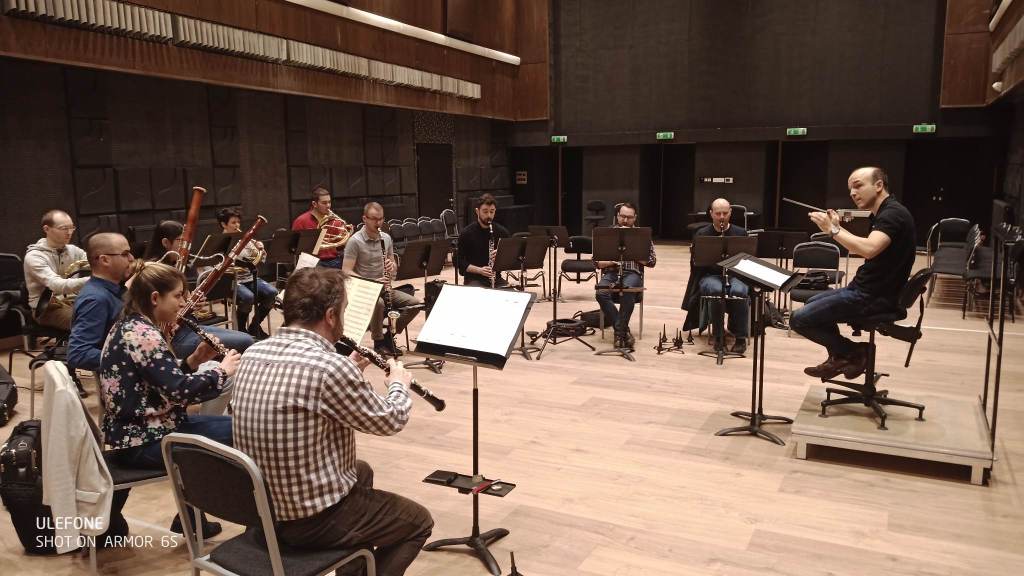
For those who find what happens in a symphony orchestra a mystery, including the conductor’s completely obscure and visual incantation-like activity, the institution of a rehearsal may raise a double question mark. And yet musicians – except perhaps opera singers – spend the vast majority of their time sitting in endless rehearsals, and the sense of it all is often, let’s be honest, not clear even to them.

The basic expectation (which of course is rarely fully met) is that everyone arrives fully prepared for the first orchestral rehearsal so, in theory, the 3-hour orchestra rehearsal is not the place for individual practice (depending on the size and quality of the orchestra, such an occasion costs the orchestra’s owner around 500,000-1,500,000 HUF). What is it good for then? Well, ideally, if everyone knows everything, it’s “just” a matter of setting the proportions, climaxes, tempos, characters, pitches, timbres in a uniform manner, and that’s all the conductor’s responsibility. It’s not his job, because the baton would not make a sound even for God’s sake, but he has to settle these “matters” reassuringly before the orchestra can perform in front of an audience. The full realization of such a thing differs from person to person, some need one, some would need thirty to achieve satisfaction, but this is only one of the building stones of success.

It is also a matter of the rehearsals in what state of mind the musicians will go into battle, how much confidence they will have in the conductor,whether they dare to trust him in an otherwise stressful concert situation, and whether the conductor – like a good military leader – can pull some unexpected stunt in front of the audience, which will turn his orchestra wild, close to a catharsis. Will those 50-80-100 people who are all masters of their craft (in their own opinion, usually the greatest masters) and who often know more about the details of the performance than the maestro himself, become his instrument? Well, you can guess this already during the rehearsal process, and although many times a concert by a good rehearsing conductor turns into a boredom and vice versa, rehearsal is an act of establishing (mutual) trust.

Like the date before the act of love, you need it if you want a lasting experience later. But trust goes both ways, so one of the biggest “wow” experiences for young conductors is when they first start to trust the orchestra (own experience). This is when miracles happen, however without this confidence, the most serious rehearsal process and the most prepared baton virtuoso can only expect a mediocre, slightly uninspired and certainly forgettable performance on stage. Nevertheless, all those people bought their tickets not for fake sighs…

So, let’s trust the orchestra and miracles will happen!

______________

Author: Máté Hámori

Let’s share!

2023.05.06.
concert, culture, sharing

There’s a word that gives me shivers, chills down my spine, solid nausea, in a bad sense, unfortunately I can’t help it. The word spread in public discourse at the speed of covid, and journalists happily tossed ‘oven-ready’ solutions into the ether without any distracting thinking or such, with a happy/vacant smile, and now it has become a common term to intersperse wording in laws and serious analyses.

Ah, well. We’ve unfortunately seen expressions like “culture” of consumption, but now we’re here with “culture consumption”. Which is such bullshit as love-planning, pain culture, soup-slicing, slimming jelly, etc. Culture – whatever it is, but let’s say it’s mostly a state of being, or rather a direction of it – cannot be consumed. Moreover, consumption is nowadays a word with increasingly negative connotations, which is immediately associated in the imagination with the idea of defecation, of getting rid of the substance consumed (including the associated stench).

So consumption is basically a consuming, decomposing, so to speak, a saprophytic behavior: it uses the energy of dead creatures to survive. At first sight, it’s all right to think of going to a concert as a way of recycling the intellectual products of dead beings (de-composers) for the purpose of relaxing or contemplating or for whatever purpose. But that’s not culture. Culture does not degrade, it creates. It is not dead, it is alive; in fact, it is the very medium of life in a certain social approach. And we don’t consume it, but we share it. Those who attend a concert are not passive consumers (a.k.a. fungi), but are an essential component of active creation and recreation. It participates in bringing the resurgence of music to life, sharing the experience with others, creating a community in the moment when hundreds of people are raving / weeping / mourning / listening in silence / boring / laughing together.

A classical, humanist human being sharing culture couldn’t be further from the consumer, the postmodern human caricature who shovels trash food with desperate loneliness. That’s the reason why people still go to concerts, to theatre, and I would venture, to church, and perhaps even more – because we have a need for sharing, the number one building block of community.

Because consuming is a damn lonely thing to do, and loneliness, along with emptiness, is what we humans fear the most.

______________

Author: Máté Hámori

Everyday miracle

2023.04.06.
classical music, composing music, Easter, Péter Zombola, Passion

I don’t know whether significant events exist. Perhaps I would say no, because everything that happens is just repetition, a predictable and calculable everyday event from birth to death. But for me, the moments when a new work of art is born always stand out in the everyday events, and by that I mean what the word really means: real art.

Passion composed by Péter is real. And music, in a sense for what I want to be involved in music for the rest of my life, and at this point, unfortunately, words fail me, I can’t put this particular “in a sense” in words, perhaps it can’t even be put.

The good thing about this piece is that the composer is concerned with nothing but pure music, and he is able to dissolve his own inner world into music with apparent ease. And how good it is to find out that there are still people who have this level of inner life that can stretch and fire a seventy-minute piece.

Because the piece is about Péter Zombola, not about Jesus Christ, and this statement may not shock anyone who cares about art in 2015. That’s right, old stories only make sense when we ourselves become the protagonists. It is perhaps no coincidence that, for centuries, the Passion Play has seen different actors taking up the cross and carrying it to the village calvary each year, not to mention the more extreme examples of this identification, say in the Philippines.

And the words of the story appear like dead letters from a dusty bible ground between the teeth of the scientist who found the Book, running his finger over the lines – yes, that’s the text, that’s the story word for word, I remember that. But what’s actually happening, as in the works of the great predecessors, is not revealed by the story. What’s beautiful is that the music begins to speak where the words fall silenced: in the interludes interspersed between the choral movements and in the prelude and postlude music that frame the piece.

It is these movements that give the piece its vein, their tension that holds together this substantial construction, in which the biblical lines blabbered by the choir merely wander as commentaries under those vast domes. It is like Bluebeard’s castle: dark, full of pain and blood, yet not cold. This castle is heated by a profound love, and this love transforms even the otherwise ruthless and unbiased choir in the plea of the penultimate movement, even if the initially whispered request later grows into a howling demand: love in this piece has transformed the world, transformed humanity.

The neutral evenness of the universe, Kubrick’s monolith, is equally present in the post-love world, where the canon of recurring questions chanting “why?” is repeatedly filtered through the Babylonian noise of humanity. And the answer is an old church hymn I heard so often as a child from the old women’s choir, which accompanied the ever-false organ lagging beats behind: Sweet Jesus, for you I live, Sweet Jesus, for you I die…

It’s good to know that art is not over yet. There will be something to get up for tomorrow.

______________

Author: Máté Hámori

Kalos – Beauty in the world

2023.03.11.
beauty, classical music

According to the story, when a young inventor showed Leonardo the blueprints of his latest flying machine, the master took only one look and declared that the contraption would never fly. And how can you be so sure? – panted the scalded colleague. Because it’s not nice – was the answer.

The story, apart from being nice (!), carries a deeper meaning. A secret knowledge, if you like, that has been almost completely lost to our post-scientific age because of the misunderstanding of man living in the age of science. The beauty hidden in the snowflake, in birth, in memory, or in the ticking of the clock is not just a bushel on the hat of reality: it is the deepest and truest meaning of reality itself – at least for us.

For what is it that makes us different from our ancestors, what has evolution given us humans that makes us stand out from the animals? Perhaps empathy, wisdom, the ability to plan? Unfortunately, this is quickly disproved by a glance at the front page of any newspaper. . The gift that man first received in creation is the greatest discovery we have made in the last two million years is: beauty. This discovery opened the door to the other world, it spurred us on to explore the terrestrial world, it shaped our laws and the order of our states, it guarded our greatest enterprises from the pyramid of Cheops to the discovery of Antarctica, it taught us to respect and to desire, it made us human.

Beauty is the daemon that inspires the whole world in our eyes, that gives meaning to bean soup and late-night conversations, to science and the sadness of the aunt on the tram. Let’s cherish this treasure, because through it we have come to love ourselves and the whole universe. Don’t let love shrink in you! Don’t let beauty fade away! Keep the flame alive!

______________

Author: Máté Hámori

Ode

2023.02.13.
art, catharsis, classical music

Here I am sitting. It has happened to everyone, and will happen to everyone as long as there is a human being on Earth. More correctly, “man” will live on Earth as long as this happens to him. It happens to him, and he dies, because he has to die. This is how it is defined, with the French ‘petit mort’ only mentioned in parentheses.

My dear fellow human beings: I can wish you nothing better, nothing more, than to live this great and small death. No matter if it’s once or a hundred times, just let that light come on, just let that fearful fluttering in your stomach, just cry and laugh, be disappointed and perish in all love, believe that there can be “something” before the “nothing” consumes everything.

Art is a very simple thing, it starts and ends here: from the ‘petite mort’ to the ‘grande mort’. There it is in the sounds, in the dead black notes, the feeling that has torn a man apart, blown him to heaven and cast him into hell. The man is no longer alive: I say Mahler, I say Bartók, but these are just names, letters. Their little deaths have survived that final, that all-covering dies irae, dies illa. And now I, a late offspring, with the storm-torn, living hearts of great old lovers in my hands, I cry out to the darkness: Oh death, where is your sting?

______________

Author: Máté Hámori

Thanksgiving at the start of the year

2023.01.02.
2023, beginning of the year, classical music, start of the year, Thanksgiving

“Fine, Laus Deo!” At the end of many of Haydn’s scores you will often find this prayer – “end, glory to God!”. Of course, there may be a sigh of relief in this (see: “Mama, look, oh, this poem is also done!” J.A.), but there is something even more important. And that is – gratitude.

Revolutions and wars followed each other, human suffering often escalated to the point of the unbearable, and all the while Beethoven, Haydn, Bach and Bartók were composing. When mere survival was the purpose, when famine and plague devastated the world, when whole countries and peoples disappeared in a matter of decades – Omar Khajjam, Dante and Villon wrote poetry. At a time when murder was being committed in the name of religion, the majority of the inhabitants of the world were living in inconceivable poverty, when seven out of ten children did not survive adulthood – Giotto, Titian and Goya were painting.

And what has changed since then? Everything is the same, let’s not deceive ourselves. Europe has achieved prosperity and longevity for its citizens, but never before have so many people on the planet suffered as they do today. Every day, when I wake up, I am struck by the same feeling that might have swept over Haydn, Liszt or Thomas Mann and tens of thousands of “non-geniuses” like me throughout history – gratitude.

The gratitude that what I had dreamed of as a child became a reality, albeit with hard work and perseverance: art became my life. I wake up and lie down with giants, surrounded by wonderful people who bring the giants to life with their instruments again and again.

But gratitude is an obligation: the many rehearsals, practices and concerts are for those who are often perhaps less grateful for their lives. For whom the light that shines in every child’s eyes has faded a little, or, apparently, gone out. Music is hope and light and, as our father Kodály so beautifully put it, it belongs to everyone. It’s yours and theirs too.

______________

Author: Máté Hámori

Me-Mo-Ry! – Preparing: The conductor! 3. part

2022.12.02.
classical music, conductor, Máté Hámori, memory

Preparing: the conductor! (Part 2)

2022.11.09.
classical music, conductor, Máté Hámori, Mozart

We took our next fresh, crisp score at the end of the previous part and played it through on the piano thoroughly, just to get to know it. The instrument is important to me for two reasons: firstly, it helps to clarify passages difficult to hear at first reading, and secondly, the medium of music is physical vibration after all – and often what is not immediately “visible” on paper gets immediately brought out by the sound, for example the character of a theme or the significance of a counter-melody. It’s the same with poetry: sometimes you have to recite a line loud to understand, or rather perceive, what it’s about.

F.A.Q.

When closing down the piano, we reach a stage of preparation that for many (well, most of the) people is a mystical experience hard to perceive. This is the part when the conductor glares at the score blankly for hours. The most common question in this regard: “do you actually hear what’s written there?!”

Well, for most musicians, the principal weapon is inner hearing. Not much technical literature have I found, although I sought. . In Hungarian, Iván Vitányi’s The Psychology of Music is the most detailed work on the subject, but it does not fully articulate what this actually is. Based on my own experience, I would compare it to a simulator that mixes millions of sound samples stored in the brain to produce a sonic image that changes with each re-reading, initially being sketchy, then becoming more and more detailed, which the musician then tries to reproduce on his instrument or on the orchestra.

For the conductor, the process of learning consists in the grooving and polishing of this inner sonic stream, and precisely because of the way this simulator works, it never ends. I would venture to say that there is no point in time at which you have learnt the piece and you are done. We always arrive at a certain subtlety in this inner sonic image, which can always be further refined – of course, within the limits of the individual’s abilities.

Let’s say, for example, that the young conductor opens the score of Mozart’s “Great” Symphony in G minor for the first time:

It usually starts by getting to know the melody and hearing it from the inside – firstly at a tentative tempo, without dynamics or timbre.

Then he also discovers the basses he will mentally match to the melody.

Then, struck by lightning, he discovers the “diabolical” difficulty of the melodies the viola received already in the first bars.

He puts all this knowledge together and now hears a three-layered fabric – without tempo, color, dynamics or proportions.

Forgetting the good old music school mantras, it is usually only then that the eager youngster realizes that the piece has a tempo signature and dynamics.

He then begins to search for the right tempo, in which the movement of the first violin melody, the playability of the viola parts and Mozart’s tempo marking are all important factors. What the novice conductor does not know here is that they can only find a real, workable tempo if they have embraced the whole movement as described above and has taken into account the “tempo needs” of the different themes.

Now the real refinement starts: the brain slowly begins to blend the melody and the accompaniment with their respective violin and viola timbres, to establish the proportion of the accompaniment (30% bass, 45% violin, 25% viola), and to ponder the phrasing: does the musical phrase begin in the 3rd or 1st bar? (This is often the most difficult thing to mull over: in this particular case, for example, I don’t think there is a clear answer.)

This phase actually lasts the longest, and the more splendid the (master)piece is – the longer it can last. That is why it is possible to conduct the above symphony five hundred times, because the shaping of the piece never ends. Often, a different tempo seems more interesting, a counter-melody becomes more significant, a character changes: the pieces living inside evolve with us. That’s why you can happily pursue this vocation until you pass away, you can never get bored.

(to be continued …)

______________

Author: Máté Hámori

  • 1
  • 2
  • »
2024 ® MATÉ HÁMORI
ALL RIGHTS RESERVED
We use cookies on our website in order to provide the most relevant site experience by remembering your preferences and visits. By clicking the "Accept All" button, you consent to the use of ALL cookies. However, you can visit the "Cookie Settings" menu item and give partial consent.
Cookie SettingsI accept all
Manage consent

Privacy Overview

This website uses cookies to improve your experience while you navigate through the website. Out of these, the cookies that are categorized as necessary are stored on your browser as they are essential for the working of basic functionalities of the website. We also use third-party cookies that help us analyze and understand how you use this website. These cookies will be stored in your browser only with your consent. You also have the option to opt-out of these cookies. But opting out of some of these cookies may affect your browsing experience.
SAVE & ACCEPT
  • Magyar (Hungarian)
  • English